ABOUT US
Sed ut perspiciatis unde omnis iste natus error sit voluptatem
accusantium doloremque laudantium, totam rem aperiam,
GET A FREE QUOTE

Which Hydraulic Piling Rig Fits Compact Urban Foundation Sites?
-
 author
 - 7,August
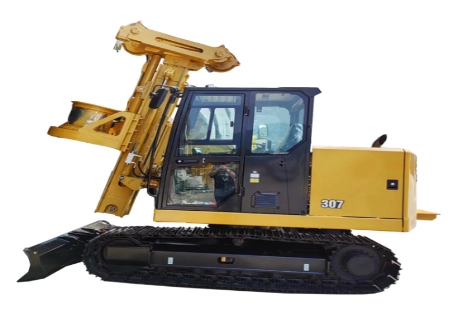
Urban foundation work rarely offers a clear, open platform. A rig may need to pass through a narrow gate, turn beside an existing building, drill below overhead services, and finish without disrupting homes or businesses nearby. For contractors, the right compact hydraulic piling rig is therefore not simply the smallest machine available. It must fit the access route, meet the pile design, handle the ground, and maintain a practical production rate.
This choice matters more as urban renewal, utility upgrades, and data-center construction move into developed areas. Noise limits are tighter, nearby structures are sensitive, and lost time is expensive.
Start With the Site Envelope, Not the Rig Brochure
Before comparing torque or engine power, map the complete path from the delivery vehicle to each pile position. The narrowest gate is only one constraint. Corners, slopes, weak paving, overhead cables, basement slabs, and space for spoil removal may decide whether a machine can work safely.
Record these limits:
- Minimum access width and turning space
- Maximum transport and working height
- Ground-bearing capacity along the travel route
- Distance to walls, utilities, scaffolds, and live traffic
- Available area for casing, drilling tools, concrete trucks, and spoil
- Permitted working hours and local noise restrictions
A rig that enters the gate but cannot raise its mast at the pile point is not workable. Measure the operating envelope, including counterweight swing and tool handling.
Match Capacity to the Designed Pile
Once the physical envelope is known, compare it with the structural requirement. Pile diameter and depth provide the starting point, but they do not describe the whole drilling load. Dense sand, gravel, weathered rock, old foundations, and uncontrolled fill can demand more torque and pullback than a simple bore schedule suggests.
Review the selection with the geotechnical report, pile designer, drilling contractor, and equipment supplier. This connects machine capacity with real resistance below ground.
Diameter, Depth, and Torque Must Be Read Together
A mini rig may reach the stated depth in clay yet struggle at the same depth in gravel. Likewise, a maximum diameter is not a promise of full production in every formation. Ask for the rated torque, crowd and extraction force, winch capacity, rotary speed range, and the drilling method used to achieve the published depth.
For example, our TR10 Mini Rotary Drilling Rig is designed for very restricted locations. It can drill up to 12 m and supports bore diameters from 400 mm to 800 mm. Its body width is 1,680 mm, while the hydraulic system delivers a main-pump flow of 88 L/min. Those figures make it a useful candidate for courtyards, narrow urban plots, and low-headroom tasks, provided the pile design and geology remain within its working range.
Ground Conditions Decide the Tools and Support System
Clay, silt, sand, gravel, and weathered rock do not behave alike. Cohesive soil may remain open long enough for a straightforward bucket cycle. Loose saturated sand can require casing or drilling fluid. Gravel may call for stronger interlocking kelly bars and suitable buckets, while buried concrete can stop progress unless a planned obstruction tool is available.
Use the bore logs to confirm:
- Expected soil layers and groundwater level
- Cobbles, boulders, old piles, or demolition fill
- Need for temporary casing or slurry support
- Suitable auger, bucket, core barrel, or rock tool
- Method for checking verticality, final depth, and base cleanliness
This is also where a compact rig’s extraction force matters. Pulling a loaded bucket or a tool from sticky ground can be harder than drilling downward.
Choose the Compact Class That Fits the Work
Compact rigs cover a wide range. Some favor doorway access and low working height; others trade a larger footprint for greater depth, torque, and output. Compare access dimensions with foundation capacity and ground conditions.
At SINOVO Rig, we offer foundation construction equipment for different project scales. For restricted urban work, our smaller rotary models give contractors several steps in capacity rather than a single all-purpose answer.
TR10 for the Tightest Access and Shallow Piles
The TR10 is the first model to examine when width and headroom dominate the project. Its 6,000 kg machine weight, excluding the drilling bucket, can also reduce transport and platform demands compared with larger rigs. Under ultra-low-headroom conditions, its working height is listed between 3,500 mm and 3,950 mm.
The trade-off is clear: maximum depth is 12 m and torque is 10 kN·m. It suits modest piles in workable soils, not deep or heavily obstructed foundations.
TR35 or TR45 When More Torque Is Needed
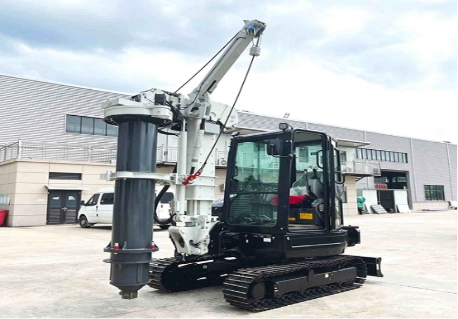
For deeper or wider urban piles, the TR35 reaches 15 m depth and 1,000 mm diameter with 35 kN·m torque. Its transport width is 2,250 mm, and the telescopic mast helps it work where a conventional tall rig cannot enter. The machine can use different tools for clay, sand, gravel, and strongly weathered rock, subject to site-specific review.
The TR45 covers the same listed maximum depth and diameter but raises rotary-head torque to 50 kN·m. Its 2,300 mm chassis width remains relatively compact, while the rubber-track undercarriage can reduce damage to finished surfaces. Choose between them by formation resistance and cycle demands, not by diameter alone.
TR60 When Production and Depth Outgrow the Mini Class
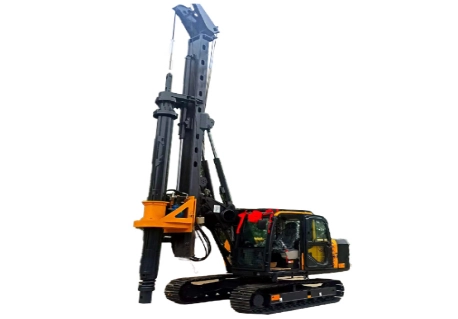
The TR60 moves into a larger working class, with a maximum drilling depth of 21 m, 1,000 mm diameter, and 60 kN·m torque. It can work with telescopic friction or interlocking kelly bars and can also support a CFA drilling system. A high spin-off speed of up to 80 r/min helps release soil from the tool during small-diameter piling.
At 2,500 mm wide and 17,500 kg working weight, it needs more access and a stronger platform. Yet it may finish a demanding project faster than a smaller rig working at its limit. Review the broader hydraulic piling rig range before fixing the machine class.
Control Noise, Vibration, and Urban Disturbance
Noise and vibration have become central planning issues for foundations beside occupied buildings, rail lines, hospitals, and utilities. Recent industry attention to quieter construction reflects stricter permit conditions and greater concern about ground-borne vibration. Drilled piling often offers a lower-impact route than percussive driving, but it is not disturbance-free.
Use a project-specific control plan:
- Complete a pre-construction condition survey of nearby structures.
- Set vibration and noise trigger levels with the project engineer.
- Monitor representative points during trial and production piles.
- Maintain cutting tools; worn teeth raise noise, heat, and cycle time.
- Avoid unnecessary high-speed rotation near sensitive structures.
- Plan truck movements, spoil handling, and concrete delivery outside sensitive periods.
The Hong Kong Institution of Engineers reports a long-term shift toward quieter foundation methods through permit control. That direction is relevant well beyond one city: contractors increasingly need evidence that their chosen method can meet environmental commitments.
Check Logistics, Safety, and Whole-Project Cost
Purchase or hire price does not reveal the full cost. Mobilization, crane support, platform preparation, fuel, tool wear, spoil handling, and delays can outweigh a small equipment-price difference.
Before awarding the package, ask:
- Can the rig travel with the kelly bar installed?
- Is a crane needed for assembly or tool changes?
- How quickly can the rig move between pile points?
- Does the ground platform support the rig in its least stable position?
Urban sites also need clear exclusion zones. A smaller machine still carries overturning, suspended-load, hydraulic, and rotating-equipment hazards. The lift plan, daily checks, emergency access, and utility clearances must reflect the actual machine configuration.
Conclusion
The best compact hydraulic piling rig is the smallest machine that can complete the designed piles with a sound margin for ground resistance, extraction, stability, and production. Start with measured access width and headroom, then test the required diameter, depth, torque, tools, and bore-support method against the geotechnical report. The TR10 suits the tightest sites and shallow work; the TR35 and TR45 add capacity while keeping a modest footprint; the TR60 becomes relevant when depth and output justify more space and platform strength. Noise, vibration, transport, spoil handling, and service support should remain part of the same decision. A careful site-and-rig review protects the program, neighboring property, and the quality of every completed pile.
FAQs
Q: What size compact hydraulic piling rig fits a narrow urban gate?
A: The TR10 body is 1,680 mm wide and weighs 6,000 kg without its drilling bucket.
Q: How deep can a compact hydraulic piling rig drill?
A: SINOVO Rig compact models cover 12 m, 15 m, or 21 m, depending on the selected machine.
Q: What fluids do TR10 operators need to plan for?
A: The TR10 carries 50 L of fuel and 40 L of hydraulic oil.
Recent Post